
Lava.jl


A Julia GPU backend that compiles Julia code to SPIR-V, targeting Vulkan. Lava.jl is three things at once:
-
A compute GPU backend with full GPUArrays.jl + KernelAbstractions.jl interface. Set
device = LavaBackend()and any KA-based GPU code runs on Vulkan. -
A graphics shader backend where vertex, fragment, geometry, and tessellation shaders are written in Julia (not GLSL). Pass regular Julia functions to
Rasterizer(vertex=f, fragment=g). -
A hardware-accelerated ray tracing backend with raygen, closest-hit, any-hit, miss, intersection shaders using
VK_KHR_ray_tracing_pipeline. Julia functions compile to RT shader stages with real hardware BVH traversal.
Unified buffer model: A single LavaArray{T,N} is usable across all shader stages. Compute kernels fill geometry, vertex shaders render it, ray tracing shaders trace against it. No copies, no format conversion.
Cross-platform: NVIDIA, AMD, Intel, Apple (MoltenVK), software (lavapipe).
Installation
import Pkg
Pkg.add(url="https://github.com/SimonDanisch/Lava.jl")
Lava is not yet in the general registry. Once tagged it will be installable via Pkg.add("Lava").
Requires:
- Julia ≥ 1.12 (set by Raycore's hard dep on 1.12; Lava itself runs on 1.11, but its required Raycore dep does not)
- A Vulkan 1.2+ driver with
bufferDeviceAddressandvariablePointers(any recent NVIDIA, AMD, Intel, MoltenVK, or lavapipe ≥ 24.x) - For graphics: an X11/Wayland display, GLFW dev libs (
xorg-dev libxrandr-dev libxinerama-dev libxcursor-dev libxi-dev libxext-devon Debian-likes)
Verify your setup:
using Lava
Lava.vk_context()        # prints device, queue family, RT capabilities
API Stability
The KernelAbstractions.jl / GPUArrays.jl interface (LavaBackend, LavaArray, @kernel, broadcasting, reductions) is considered stable. This is the standard Julia GPU ecosystem API and behaves like any other backend.
The graphics and ray tracing APIs (Rasterizer, GraphicsPipeline, RayTracingPipeline, HardwareAccel, etc.) are functional but still evolving. Expect breaking changes as we iterate on the design.
Quick Start
using Lava, KernelAbstractions

# Compute: drop-in replacement for CUDABackend() or ROCBackend()
backend = LavaBackend()

@kernel function vadd!(C, A, B)
    i = @index(Global)
    C[i] = A[i] + B[i]
end

a = LavaArray(rand(Float32, 1024))
b = LavaArray(rand(Float32, 1024))
c = LavaArray{Float32}(undef, 1024)

vadd!(backend)(c, a, b; ndrange=1024)
@assert Array(c) ≈ Array(a) .+ Array(b)
# Graphics: Julia functions as shaders, no GLSL
pipeline = Rasterizer(
vertex = (pos, mvp) -> set_position!(mvp * pos),
fragment = (color,) -> color,
)
draw!(pipeline, framebuffer; vertices=mesh, uniforms=params)# Hardware Ray Tracing: Julia-side TLAS with mesh-update support
using Raycore: RTRay, RTHitResult
using GeometryBasics, StaticArrays, LinearAlgebra
hwtlas = HWTLAS(LavaBackend())
push!(hwtlas, mesh, SMatrix{4,4,Float32}(I); instance_id=UInt32(1))
Raycore.sync!(hwtlas)
rays = LavaArray([RTRay(0,0,5, 0, 0,0,-1, 1f3)])
hits = LavaArray(fill(RTHitResult(0,0,0,0,0,0,0,0), 1))
trace_closest_hits!(hits, rays, hwtlas.hw_accel, 1)HWTLAS is the recommended high-level entry point. It owns the Vulkan TLAS
- BLAS lifecycle, supports incremental geometry updates via
push!/delete!/update_transform!, and implements theRaycore.AbstractAccelcontract so the same code works against software and hardware backends.HardwareAccelremains available as a lower-level handle for advanced users who need direct control of the pipeline/SBT.
Benchmarks — AMD RX 7900 XTX
Render benchmarks using Hikari wavefront volume path tracer via RayMakie, and AcceleratedKernels.jl compute benchmarks. AMD RX 7900 XTX / Ryzen 9 7900X. Full benchmark suite in RayDemo.
Ray Tracing (Hikari scenes)
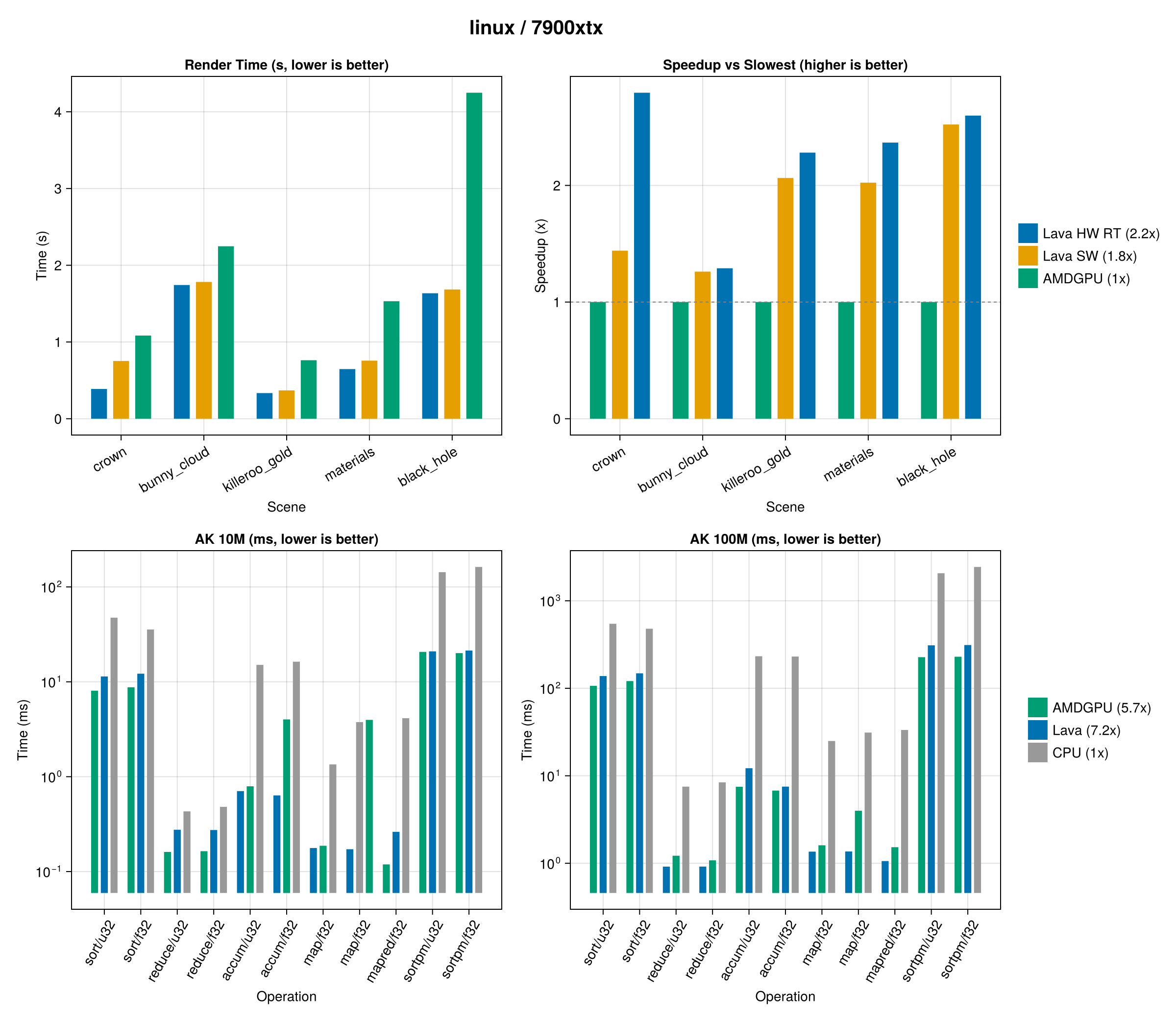
Lava SW is 1.4-2.5x faster than AMDGPU across all scenes. Hardware RT adds another 1.0-2.3x on geometry-heavy scenes (Crown, Killeroo Gold). Compared to pbrt-v4 on 24 CPU threads: 5-32x faster.
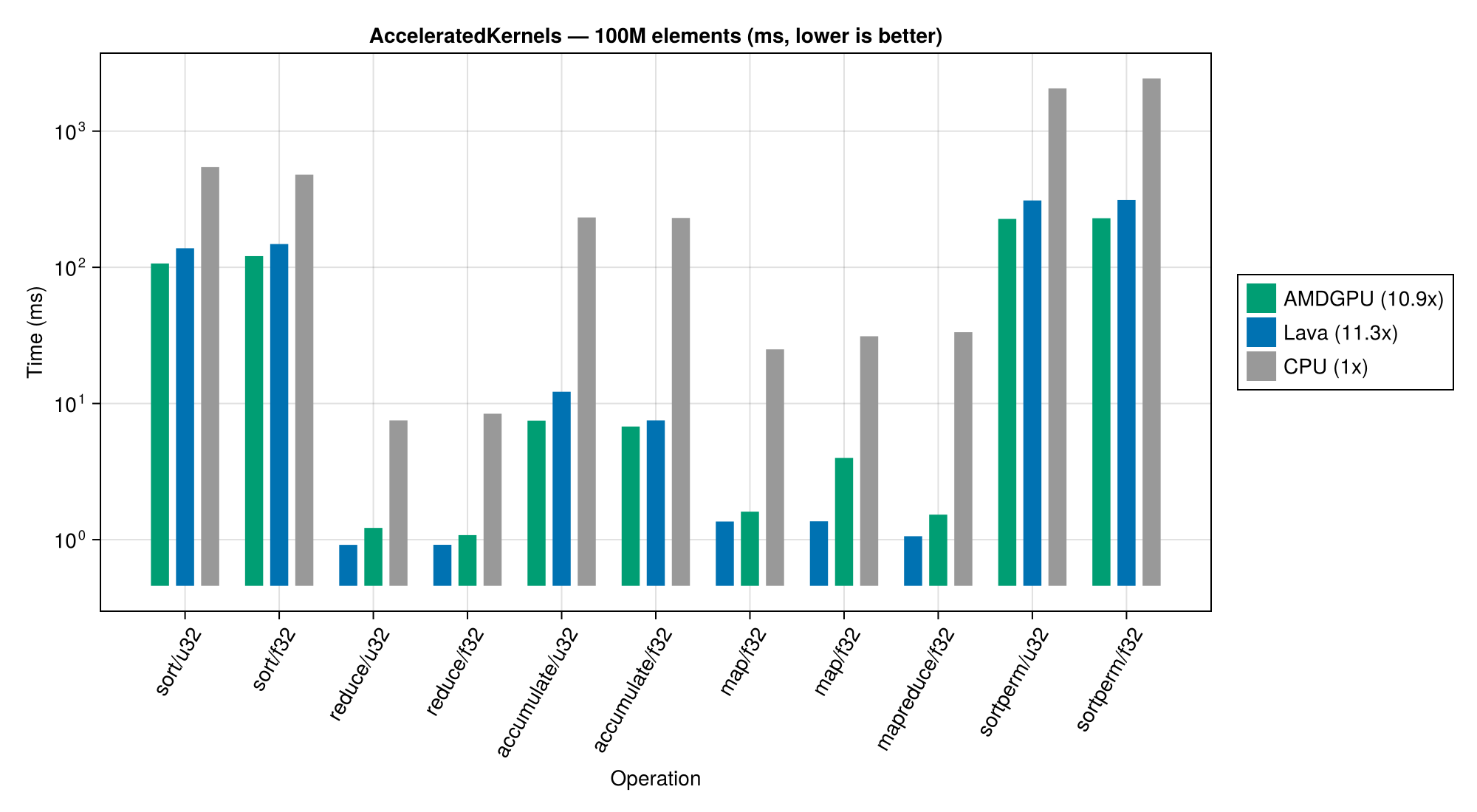
AcceleratedKernels — 100M elements
AcceleratedKernels — 10M elements
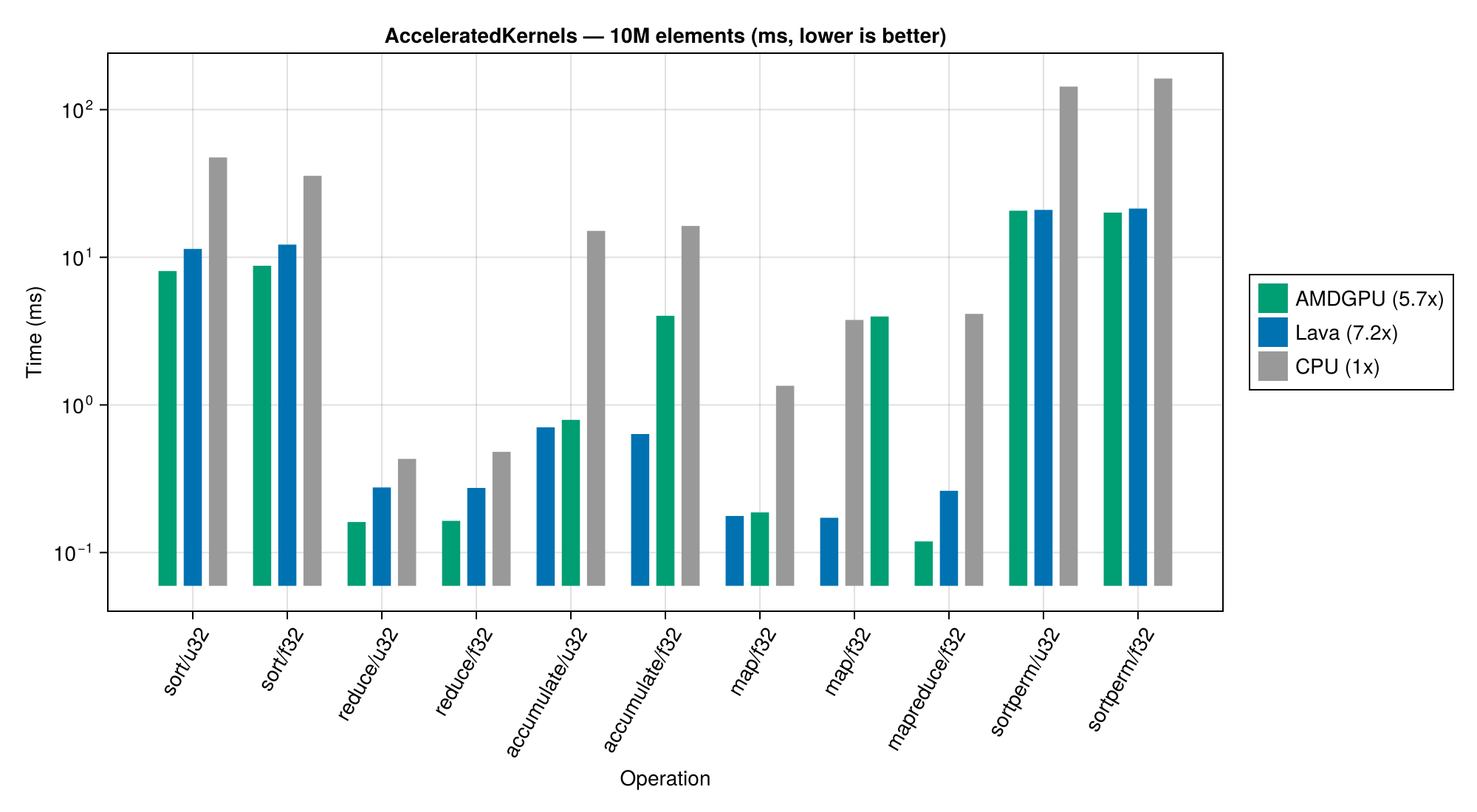
Lava wins on compute-bound and dispatch-sensitive operations (up to 23x faster on map/sin at 10M). AMDGPU wins on memory-bound operations (sort, sortperm) where its native HIP driver has an edge.
Benchmarks — NVIDIA RTX 4000 Ada Generation
Same workloads on NVIDIA RTX 4000 Ada (driver 595.80) / Ryzen 9 7900X. Full data and methodology in RayDemo.
Ray Tracing (Hikari scenes)
Median of 3 trials (after 1 warmup), in seconds. Best per row in bold.
| Scene | Resolution | spp | pbrt-v4 OptiX | CUDA | Lava SW | Lava HW RT |
|---|---|---|---|---|---|---|
| Crown | 500×700 | 16 | 2.372 s | 2.752 s | 1.844 s | 1.291 s |
| Bunny cloud | 960×540 | 8 | 3.459 s | 1.310 s | 1.146 s | 1.142 s |
| Killeroo (gold) | 684×513 | 32 | 1.541 s | 0.889 s | 1.246 s | 1.191 s |
| Materials | 1200×900 | 10 | 1.503 s | 0.886 s | 1.232 s | 1.164 s |
| Black hole | 800×450 | 32 | — | 2.089 s | 1.870 s | 1.945 s |
Lava HW RT beats pbrt-v4 OptiX on every comparable scene (Crown 2.2×, Bunny cloud 3.0×, Killeroo 1.3×, Materials 1.3× faster). Against the CUDA path of the same Hikari integrator, Lava wins on the volumetric scenes (Crown, Bunny cloud, Black hole — where shader-side complexity dominates) while CUDA wins on the surface-only scenes (Killeroo, Materials — where Lava is still dispatch-overhead-dominated at this scale; sub-ms-per-dispatch matters less for compute-heavy paths).
pbrt-v4 was built from upstream master 91bc6ca against CUDA 13.3 + OptiX 9.1 on the same machine. Black hole has no .pbrt counterpart (Julia-only spacetime-medium scene).
Note on the pbrt-v4 comparison. Hikari (the integrator behind the Lava and CUDA columns) is a port of pbrt-v4's volumetric path tracer — MIS, light sampling, RR, the delta-tracking pattern for media all mirror pbrt — and it implements every surface/material type (
diffuse,conductor,dielectric,thindielectric,coateddiffuse,coatedconductor,diffusetransmission,interface) and camera sensor (canon_eos_5d_mkiv,nikon_d850, default CIE 1931) these scenes use. Two scene-fidelity gaps are still open on the Lava/CUDA side: (a) Killeroo's grid floor/walls — the pbrt parser was extended to accept spectrum-classscaletextures (the floor diffuse now resolves to aTexture{RGBSpectrum,2}with the right line-pattern Kd), but the rendered floor still looks flat-grey at normal contrast, indicating the spectrum-texture UV path isn't producing varying output downstream of the resolved material; (b) Crown's gold/sapphire/pearl displacement maps — aBumpMapped{Inner, BumpTex}wrapper material was added and is registered in the GPU material set with properTextureRefconversion, but the perturbed shading frame doesn't visibly change the rendered surface yet. Both gaps are now in Hikari/RayMakie, not the pbrt parser; the timings above are for renders that are still missing Crown's displacement detail. BSSRDF (separable subsurface) and hair BxDFs are also not yet implemented; none of these scenes use either.
AcceleratedKernels — 100M and 1M elements
Median ms, lower is better. ← = Lava ≤ CUDA on that op.
| Operation | CUDA 1M | Lava 1M | ratio | CUDA 100M | Lava 100M | ratio |
|---|---|---|---|---|---|---|
| sort/UInt32 | 0.713 | 7.694 | 10.79× | 113.194 | 130.218 | 1.15× |
| sort/Float32 | 0.892 | 9.957 | 11.16× | 139.821 | 158.075 | 1.13× |
| reduce/UInt32 | 0.031 | 0.244 | 7.87× | 1.276 | 1.285 | 1.01× ← |
| reduce/Float32 | 0.030 | 0.236 | 7.87× | 1.287 | 1.277 | 0.99× ← |
| accumulate/UInt32 | 0.047 | 0.667 | 14.19× | 11.912 | 51.102 | 4.29× |
| accumulate/Float32 | 0.045 | 0.681 | 15.13× | 11.893 | 45.959 | 3.86× |
| map/Float32 (acck_2x) | 0.025 | 0.135 | 5.40× | 2.844 | 2.716 | 0.95× ← |
| map/Float32 (acck_sin) | 0.017 | 0.136 | 8.00× | 2.854 | 2.737 | 0.96× ← |
| mapreduce/Float32 (acck_sin) | 0.031 | 0.226 | 7.29× | 1.295 | 1.282 | 0.99× ← |
| sortperm/UInt32 | 1.063 | 10.290 | 9.68× | 309.817 | 446.300 | 1.44× |
| sortperm/Float32 | 3.767 | 12.028 | 3.19× | 1450.118 | 447.890 | 0.31× ← (Lava 3.2× faster) |
At 100M Lava ≤ CUDA on 6 of 11 ops — reduce, map, mapreduce all tie or favor Lava, and sortperm/Float32 is 3.2× faster (CUDA's float comparator with NaN handling is heavy here). Sort closes to within 15% of CUB. The remaining gaps (accumulate, sort) are vendor-tuned-kernel territory (CUDA's CUB / Thrust). At 1M most ops are dispatch-overhead-bound — Lava's per-record cost is 1.51 µs vs CUDA's effectively free stream queuing, which dominates total time when each op is sub-ms.
Architecture
Lava.jl uses a custom LLVM IR to SPIR-V emitter written in Julia (~6,000 lines). This is not a wrapper around llc or the SPIRV-LLVM-Translator. It reads the LLVM module via LLVM.jl and emits SPIR-V directly, giving full control over all shader stages and Vulkan extensions.
Julia function
  |  GPUCompiler.jl
LLVM IR (via LLVM.jl, LLVM 18)
  |  LLVM passes: GEP lifting, StructurizeCFG, Vulkan preparation
  |  Custom SPIR-V emitter (~40 LLVM opcodes to SPIR-V)
  |  spirv-val validation
VkShaderModule -> VkPipeline -> GPU dispatch
Why not llc? The LLVM SPIR-V backend crashes on geometry shaders, rejects ray tracing extensions, and doesn't support key Vulkan extensions (SPV_KHR_physical_storage_buffer, SPV_KHR_variable_pointers). These are missing C++ instruction selection patterns with no upstream fix planned. The custom emitter handles all shader stages from day one.
Features
Compute
- GPUArrays.jl: ~99.9% test suite pass (9,578 passed, 26 failed across 27 groups)
- KernelAbstractions.jl: Full
LavaBackend <: KA.GPUwith@kernel,@index,@localmem,@synchronize, and@print - Atomix.jl: Int32/UInt32/Float32 atomics (add, sub, and, or, xor, xchg, min, max; Float32 add via CAS loop)
- On-kernel printf: portable
KernelAbstractions.@printand Lava's@lava_printfviaNonSemantic.DebugPrintf— see Debugging - Complex structs: Deeply nested types, NTuple fields, multi-field structs pass through BDA without corruption
- Hikari raytracer: Full wavefront volume path tracer (93 source files, 20 materials, 6+ kernel stages) renders correctly
Graphics
- Vertex, fragment, geometry, tessellation shaders from plain Julia functions
Rasterizer,TrianglePipeline,LinePipelinehigh-level APIsRenderWindowwith GLFW + swapchain,LavaFramebufferfor offscreenLavaTexture2D,LavaSamplerwith descriptor set management- Blend modes, culling, depth testing, topology selection
Ray Tracing
VK_KHR_ray_tracing_pipeline+VK_KHR_acceleration_structure- BLAS/TLAS build from triangle meshes
RayTracingPipeline(raygen=f, closest_hit=g, miss=h)with Julia functions as RT shadersHardwareAccelintegration with Hikari/Raycore for drop-in HW RT- Multi-field payloads, any-hit shaders for alpha transparency
- Shadow rays with multi-round host dispatch
Performance
- Dispatch overhead: 1.8us per dispatch (vs AMDGPU 8.8us), 11x improvement via
@generatedarg packing, pipeline cache, ghost type optimization - Throughput: 2x faster than AMDGPU on single-dispatch 10M-element kernels
- Hikari 10spp 1200x900: ~1.42s (vs AMDGPU ~1.69s, 16% faster)
- Batched dispatch: Multiple kernels recorded into a single command buffer, submitted together
- Unified/BAR memory: Auto-detected for small buffers, eliminates staging copies
Kernel Arguments: Buffer Device Address (BDA)
All kernel arguments are packed into a device-memory buffer with a single i64 push constant pointing to the BDA. No descriptor sets per buffer, no 256-byte push constant limit. One push constant, unlimited arguments.
Source Structure
src/
├── Lava.jl                          # Module, exports, debugging API
├── compiler/
│   ├── compilation.jl               # Pipeline orchestration, LLVM pass coordination
│   ├── target.jl                    # GPUCompiler target (LavaCompilerTarget)
│   ├── entry_wrapper.jl             # BDA argument buffer wrapping
│   ├── passes/
│   │   ├── lift_geps.jl             # Byte-offset GEP to typed GEP (3 passes)
│   │   ├── structurize_cfg.jl       # CFG fixup + StructurizeCFGPass
│   │   ├── prepare_vulkan.jl        # 8 Vulkan IR transforms, shared mem flattening
│   │   └── lower_intrinsics.jl      # Math/barrier/thread-index lowering
│   └── spirv/
│       ├── module.jl                # SPIR-V module builder, ID allocation, serialization
│       ├── types.jl                 # LLVM to SPIR-V type mapping, opaque pointer recovery
│       ├── emit.jl                  # Core emitter: ~40 opcodes, control flow, decorations
│       ├── graphics.jl              # Graphics shader entry points
│       └── raytracing.jl            # RT shader stages, OpTraceRayKHR
├── device/
│   ├── math.jl                      # Float32 GLSL.std.450 + Float64 fallbacks
│   ├── quirks.jl                    # @device_override for GPU-safe replacements
│   ├── atomics.jl                   # Atomix.jl integration, CAS loops
│   ├── rt_intrinsics.jl             # RT builtins (trace_ray, payload I/O)
│   └── gfx_intrinsics.jl            # Graphics builtins (vertex_index, frag_coord, etc.)
├── runtime/
│   ├── device.jl                    # Vulkan device/queue creation, feature detection
│   ├── memory.jl                    # Buffer allocation, BDA, staging, mapped memory
│   ├── command.jl                   # Command buffer pool, batched submission
│   ├── launch.jl                    # lava_launch!, arg buffer pool, vk_flush!
│   ├── pipeline.jl                  # VkShaderModule + pipeline caching
│   ├── errors.jl                    # LavaError, validation layer capture
│   └── intrinsics.jl                # Runtime intrinsic helpers
├── array/
│   ├── lavaarray.jl                 # LavaArray{T,N} + LavaDeviceArray
│   ├── gpuarrays.jl                 # GPUArrays.jl interface, BroadcastStyle
│   ├── ka_backend.jl                # KA LavaBackend, @kernel/@index/@localmem
│   └── mapreduce.jl                 # GPU mapreducedim! with subgroup reductions
├── graphics/
│   ├── types.jl                     # BlendMode, CullFace, Topology, DepthMode, etc.
│   ├── api.jl                       # GraphicsPipeline, draw!, blit!, present_frame!
│   ├── pipeline.jl                  # CompiledGraphicsPipeline, draw recording
│   ├── framebuffer.jl               # LavaFramebuffer, render targets
│   ├── window.jl                    # RenderWindow, swapchain, GLFW
│   └── textures.jl                  # LavaTexture2D, LavaSampler
└── raytracing/
    ├── acceleration.jl              # BLAS/TLAS build, HardwareAccel
    ├── pipeline.jl                  # RT pipeline, SBT, vkCmdTraceRaysKHR
    ├── shaders.jl                   # RayTracingPipeline high-level API
    └── raycore_compat.jl            # trace_closest_hits!, Hikari integration
Dependencies
| Package | Role |
|---|---|
| GPUCompiler.jl | Julia to LLVM IR compilation |
| LLVM.jl (v9.4, LLVM 18) | LLVM IR manipulation and passes |
| Vulkan.jl (v0.6) | Vulkan API bindings |
| GPUArrays.jl | AbstractGPUArray interface |
| KernelAbstractions.jl | Backend-agnostic kernel API |
| Adapt.jl | Host/device type conversion |
| Atomix.jl | Atomic operations |
| SPIRV_Tools_jll | spirv-val, spirv-dis |
| GeometryBasics.jl | Vec/Mat/Point types for geometry math |
| GLFW | Window creation for graphics |
Hardware
Tested on:
- AMD RX 7900 XTX (Vulkan 1.4, RADV)
- NVIDIA RTX 3070 Laptop (Vulkan 1.3)
- lavapipe (software, CI)
Requires Vulkan 1.2+ with bufferDeviceAddress and variablePointers features.
Test Suite
Total: 14,461 passed, 0 failed, 0 errors, 1 broken — 14m52s on RX 7900 XTX
Includes:
- 319 SPIR-V emission pattern checks
- Golden-file snapshots for every shader stage (re-bless with
LAVA_BLESS=1) - 415 GPU execution tests + 1,776 struct broadcast regressions
- 7,347-test GPUArrays.jl test suite, fully clean on this branch
- 1,342 NVIDIA regression + stress checks (compute & RT)
- HW TLAS stress / mesh update / UAF safety / non-blocking sync — 2,550 tests
- Phase-M alloc/dispatch/free loop matrix — 6 progressively-harder regressions, all clean
Run tests:
using Pkg; Pkg.test("Lava")For a ~2-3 minute subset that exercises emitter, RT, atomics, graphics, disk cache, and the Phase-M alloc/free regressions (useful for CI-setup iteration or quick local sanity checks):
Pkg.test("Lava"; test_args=["fast"]) # or LAVA_FAST=1 julia --project test/runtests.jlHeadless CI uses xvfb-run — see Installation for the standard invocation.
Debugging
using Lava

# Memory usage
gpu_memory_usage()  # -> (live_bytes=..., live_buffers=..., ...)

# Full runtime state
dump_state()

# Dispatch logging
set_dispatch_logging!(true)
# ... run kernels ...
get_dispatch_log()

# Reset device after error
vk_reset_device!()
Documentation
- Dev docs — full API reference, deeper guides for compute / graphics / ray tracing, plus design notes on the emitter and runtime.
- KNOWN_ISSUES.md — actively tracked driver bugs and limitations.
- RayDemo — end-to-end example scenes and benchmark scripts.
Contributing
Bug reports and pull requests welcome. For driver-specific issues, please include Lava.vk_context() output and (where possible) a minimal reproducer using only Lava + KernelAbstractions. Test files in test/mwe_*.jl are the format we use.
License
MIT. See LICENSE.
Status
The KernelAbstractions / GPUArrays compute path is feature-complete and runs the GPUArrays test suite at ~99.7 % pass. The graphics and ray tracing paths are functional and exercised by the same Hikari path tracer that drives the benchmarks above; their public APIs are still evolving. Multi-vendor CI (currently lavapipe; NVIDIA/AMD self-hosted runners planned), additional documentation, and continued performance work are ongoing.