

MiQi
🐈⬛🪶 A lightweight, extensible personal AI agent framework with a modern desktop interface



Overview
MiQi Desktop is an Electron-based desktop application that provides a modern graphical interface for the MiQi AI agent. It combines powerful AI agent capabilities with an intuitive user interface, supporting chat interaction, memory management, task scheduling, and more.
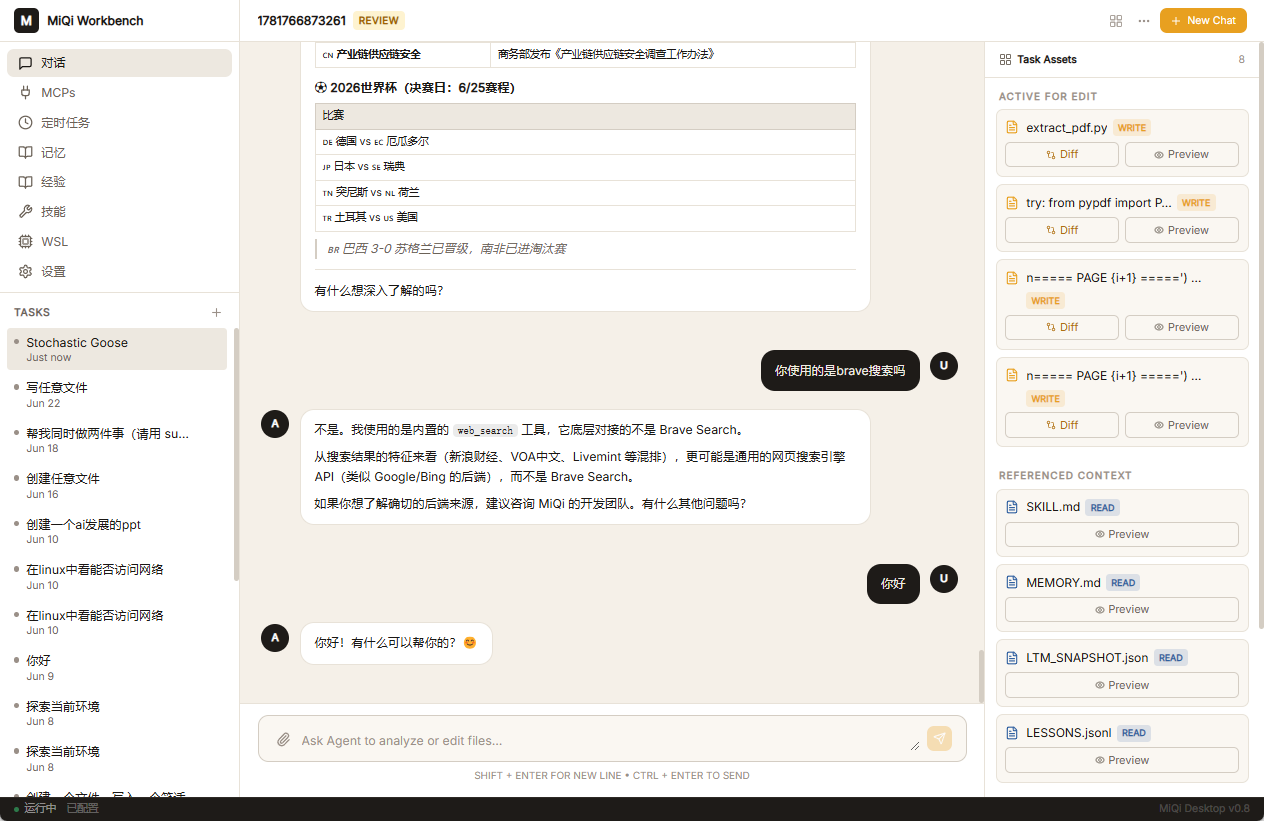
Core Positioning
- 🎯 Personal AI Agent — not just a chatbot: persistent memory, learned skills, file operations, and scheduled tasks
- 🔧 Highly Extensible — MCP protocol for external tools, custom skills, and pluggable LLM providers
- 🖥️ Native Desktop Experience — Electron with system-level integration (WSL2 sandbox, filesystem operations)
- 🔒 Local-First — all data stored locally; non-destructive file editing with versioned snapshots
- 📋 Typed Application Protocol — typed AppServer with JSON Schema catalog, method stability tracking, and handler-boundary validation
Tech Stack
| Layer | Technology | Version |
|---|---|---|
| Desktop Framework | Electron | 35.2 |
| Frontend UI | React + TypeScript | 19.1 / 5.8 |
| CSS | Tailwind CSS 4 | 4.x |
| Component Library | Radix UI + Lucide Icons | — |
| Python Runtime | Python (asyncio) | 3.11+ |
| Data Validation | Pydantic v2 | 2.12+ |
| CLI Framework | Typer | 0.20+ |
| Build (Desktop) | electron-vite + electron-builder | 3.1 / 26.0 |
| Build (Python) | PyInstaller + Hatchling | 6.20+ |
Key Features
| Feature | Description |
|---|---|
| Smart Chat | Natural language conversation with streaming responses and tool-call progress |
| Multi-Provider | OpenAI, Anthropic, Gemini, OpenRouter, DeepSeek, and more — with provider resilience |
| Typed Protocol | Typed AppServer with method specs, JSON Schema catalog, and handler-boundary validation |
| Memory System | Long-term memory snapshots, self-improvement lessons, and cross-session recall |
| Task Scheduler | Cron-based scheduled tasks with timezone support |
| Skill System | Create, upload, and manage agent skills; SkillHub registry integration |
| Plugin Ecology | MCP servers, plugins, and marketplace with deterministic catalog |
| Sandbox Execution | bwrap-based sandbox with LANDLOCK filesystem rules, streaming I/O, and process lifecycle |
| File Management | Workspace FS with watch, fuzzy search, snapshot/versioning, and non-destructive editing |
| Replay & Debug | Deterministic replay of turns, timeline, and messages for inspection |
| Session Management | Browse, search, archive, import/export conversation history |
| Desktop App | 15+ feature pages with real-time streaming, typewriter animation, and context menus |
Quick Start
Prerequisites
- Python 3.11+ — to run MiQi backend
- Node.js 20+ — to run Electron frontend
- uv — Python package manager (recommended)
Installation
# 1. Clone the repository
git clone http://git.miqroera.com/intership/miqi-desktop.git
cd miqi-desktop

# 2. Install Python dependencies
uv sync

# 3. Install frontend dependencies
cd apps/desktop
npm install
Development Mode
# Start Electron dev server with hot-reload
cd apps/desktop
npm run dev
Production Build
One-step build (recommended):
cd apps/desktop
npm run build:all    # Python backend → Frontend compile → Electron package
Step-by-step build:
cd apps/desktop

# 1. Build Python backend (generates dist/miqi-bridge.exe)
npm run build:bridge

# 2. Compile frontend
npm run build

# 3. Package as desktop application
npx electron-builder --win --publish never
The packaged miqi-bridge.exe is a self-contained binary (PyInstaller onefile) that includes Python and all dependencies — no system Python installation required on the target machine. It also supports a --check flag for environment validation:
miqi-bridge.exe --check
# Output: {"ok": true, "python_version": "3.12.10", "issues": []}
Architecture
┌─────────────────────────────────────────────────────────────┐
│                    MiQi Desktop App                         │
├─────────────────────────────────────────────────────────────┤
│  Electron Frontend                                          │
│  ├── React 19 + TypeScript                                 │
│  ├── Tailwind CSS 4 + shadcn/ui                            │
│  └── 15+ Feature Pages (Chat, Agents, Skills, MCPs, ...)   │
├─────────────────────────────────────────────────────────────┤
│  Bridge (IPC Communication)                                 │
│  ├── stdin/stdout JSON-line protocol                        │
│  ├── State synchronization + Log forwarding                 │
│  └── BridgeRuntimeLoop (persistent asyncio event loop)      │
├─────────────────────────────────────────────────────────────┤
│  AppServer (Typed Protocol Layer)                            │
│  ├── ProtocolRegistry (typed method specs)                  │
│  ├── Typed Envelopes (Pydantic v2)                          │
│  ├── JSON Schema Draft 2020-12 Catalog                      │
│  └── Handler Typed Validation                               │
├─────────────────────────────────────────────────────────────┤
│  MiQi Runtime Engine                                        │
│  ├── RuntimeSession / TaskRunner / TurnRunner               │
│  ├── HistoryRuntime + LedgerRuntime (SQLite persistence)    │
│  ├── ContextRuntime (compaction, token budgeting)           │
│  ├── ThreadRuntime (fork, rollback, import/export)          │
│  └── ReplayRuntime (deterministic replay inspection)        │
├─────────────────────────────────────────────────────────────┤
│  Execution & Sandbox                                        │
│  ├── ToolOrchestrator (approval → sandbox → execute)       │
│  ├── PermissionEngine + ApprovalPolicy + HookRuntime        │
│  ├── bwrap Sandbox (LANDLOCK, streaming, cancellation)      │
│  └── Workbench Process Runtime (command/exec, process/*)    │
├─────────────────────────────────────────────────────────────┤
│  Tools & Integrations                                       │
│  ├── Built-in Tools (filesystem, shell, web, papers, ...)   │
│  ├── MCP Client (external tool servers)                     │
│  ├── Plugin Manager + Skill Loader                          │
│  └── Office Document Tools (docx, pptx, xlsx)               │
└─────────────────────────────────────────────────────────────┘
- Launch the application
- Go through the setup wizard:
- Environment Check — validates Python and dependencies (bundled exe auto-detects; dev mode checks system Python)
- WSL2 Setup — (Windows only) auto-detects and installs WSL2 for sandbox support
- LLM Provider — configure API keys and default model
- Start chatting with the AI agent
Protocol Method Families
| Family | Scope | Methods |
|---|---|---|
turn/* | Turn | start, interrupt, steer |
thread/* | Thread | list, get, rollback, fork, delete, compact/start, inject_items |
fs/* | Filesystem | readFile, writeFile, createDirectory, getMetadata, readDirectory, remove, copy, watch, unwatch |
fuzzyFileSearch/* | Filesystem | sessionStart, sessionUpdate, sessionStop |
command/exec | Process | exec, exec/write, exec/resize, exec/terminate |
process/* | Process | spawn, writeStdin, resizePty, kill, list, get, snapshot |
replay.* | Debug | turns, timeline, messages |
config/* | Session | get, batchWrite |
model/* | Session | list, get |
feature/* | Session | list, set |
permission/* | Session | listProfiles, getProfile |
plugin/* | Session | list, install, uninstall, enable, disable, configure |
skills/* | Session | list, get, create, upload, delete, setExtraRoots |
mcp/* | Session | listServers, getServer, status |
agent/* | Session | list, get, spawn, kill |
protocol/* | Connection | catalog, method_names, schema |
Configuration
The application configuration file is located at ~/.miqi/config.json:
{
  "providers": {
    "openai": { "apiKey": "sk-..." },
    "anthropic": { "apiKey": "sk-ant-..." }
  },
  "agents": {
    "defaults": {
      "model": "claude-sonnet-4-6",
      "temperature": 0.1,
      "maxToolIterations": 100
    }
  },
  "tools": {
    "restrictToWorkspace": true
  }
}
Environment Variables
| Variable | Description |
|---|---|
MIQI_PYTHON_PATH | Custom Python interpreter path |
MIQI_AGENTS__DEFAULTS__MODEL | Override default model |
Development Guide
Project Structure
miqi-desktop/
├── miqi/                         # Python backend
│   ├── runtime/                  # Runtime engine (AppServer, Session, Turn, Thread, Replay, Agent, MCP, ...)
│   ├── agent/                    # Agent logic, tools, memory, trace, context compression, smart routing
│   ├── bridge/                   # Electron bridge service (IPC protocol)
│   ├── bus/                      # Internal message bus (async in/out queues)
│   ├── execution/                # Tool orchestrator, permissions, approval, hooks, sandbox policy
│   ├── providers/                # LLM provider implementations + resilience
│   ├── protocol/                 # Typed commands, events, permissions (runtime-frontend protocol)
│   ├── channels/                 # Chat channel adapters (Feishu, Slack, Discord, Telegram, ...)
│   ├── sandbox/                  # bwrap sandbox manager
│   ├── skills/                   # Built-in skills (cron, paper-research, feishu-report, ...)
│   ├── session/                  # Session management (Manager, SQLite store)
│   ├── config/                   # Configuration loader and schema
│   ├── cli/                      # CLI commands (agent, gateway, trace, config)
│   ├── cron/                     # Cron scheduler service
│   ├── context/                  # Context fragments, thread store
│   ├── heartbeat/                # Heartbeat service
│   ├── plan/                     # Plan tracker and tool
│   ├── documents/                # Office document tools (docx, pptx, xlsx)
│   ├── observability/            # OpenTelemetry integration
│   ├── server/                   # Server assets and configuration
│   ├── templates/                # Templates
│   ├── tui/                      # Terminal UI (Textual-based)
│   └── utils/                    # Utility functions
├── apps/
│   └── desktop/                  # Electron frontend
│       ├── src/main/             # Main process (BridgeManager, IPC handlers)
│       ├── src/renderer/         # Renderer (React pages and components)
│       └── src/preload/          # Preload scripts (contextBridge API)
├── tests/                        # Test suite (~150+ test files)
│   ├── runtime/                  # Runtime unit and integration tests (~70+ files)
│   ├── bridge/                   # Bridge protocol and audit tests (~20+ files)
│   ├── execution/                # Sandbox, permissions, orchestration tests
│   ├── providers/                # LLM provider tests
│   ├── protocol/                 # Protocol commands/events/permissions tests
│   └── agent/tools/              # Tool-level tests
├── docs/                         # Documentation (MkDocs)
├── plan/                         # Implementation plans (not in VCS deliverables)
└── scripts/                      # Build and utility scripts
Code Standards
- Python: Ruff for linting (line-length 100)
- TypeScript: ESLint for linting
- Commit Messages: Conventional Commits format
Testing
# Python backend tests (~1800+ tests)
uv run pytest

# Skip sandbox/subprocess tests for quick feedback
uv run pytest -m "not sandbox and not subprocess"

# Frontend tests
cd apps/desktop
npm run test
E2E Tests
# Electron E2E (full desktop app + bridge + LLM)
cd apps/desktop
npm run build && npx playwright test --config=playwright.config.ts --project=electron| Platform | E2E Coverage | Notes |
|---|---|---|
| Linux (Ubuntu CI) | Full suite ✓ | bwrap sandbox + all specs |
| Windows (WSL CI) | Full suite ✓ | WSL bwrap sandbox + all specs (needs MIQI_RUN_SANDBOX_E2E=1) |
| macOS (CI) | Non-sandbox only | bwrap not available; sandbox specs excluded via --grep-invert |
macOS known limitation: The "restart recall" E2E test (
session-context-recall.spec.ts) is skipped only whenprocess.env.CI && process.platform === 'darwin'(local macOS runs still exercise the test). After a full app restart on macOS ARM64 CI runners, session history (chat messages) fails to render in<main>even though the sidebar session title loads correctly and the bridge reportsrunning / initialized. This is likely a bridge IPC timing issue or APFS/SQLite WAL checkpoint race on cold start — needs native debugging. The non-restart session-switch recall test still validates #490 behavior on macOS.
Documentation
License
Contributing
Contributions are welcome! Please see CONTRIBUTING.md for details. test